
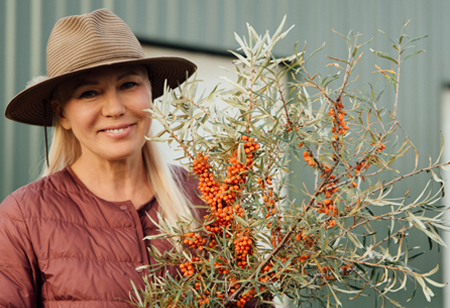
Sea Buckthorn Farming Companies

Sea Buckthorn Farming Companies are advancing sustainable agriculture through the cultivation of nutrient-rich sea buckthorn crops used in food, nutraceutical, cosmetic, and wellness applications. These organizations focus on high-quality production, innovative farming practices, and supply chain excellence to meet growing global demand for natural health-focused products.

Farm49: From Ancient Tradition to Colorado Fields
Farm49
From Ancient Tradition to Colorado Fields
Nadia Artman, Steward
Farm49 is a Colorado farm built around a single crop that remains largely unfamiliar to U.S. consumers despite its long global history—sea buckthorn. Eight years ago, its founder, Nadia Artman, made the deliberate and challenging decision to cultivate sea buckthorn berries locally, knowing it would take four to five years before the trees produced meaningful yields. That long wait, combined with the demands of meticulous, manual harvesting, made the venture a high-risk agricultural undertaking. Through sustained cultivation and steady community engagement, Farm49 has introduced this hardy, nutrient-rich berry to the U.S. market.

From Soil to Value: Sea Buckthorn Farming

Sea buckthorn farming has emerged as a distinct agricultural practice that combines ecological adaptability with strong market relevance. Cultivation systems increasingly focus on aligning natural growing characteristics with structured farm management to support reliable yields and consistent quality. The integration of sustainability principles, nutritional value recognition, and diversified end-use applications has positioned sea buckthorn farms as essential contributors to agricultural value chains. Through coordinated production practices and growing alignment with processing and distribution networks, sea buckthorn farming supports resilient supply structures while addressing evolving expectations related to traceability, quality, and long-term land productivity.

Production Expansion Turns into Labor & Harvest Coordination Challenge for Sea Buckthorn Farms

Thursday, June 11, 2026

While there are many ways to grow the market for sea buckthorn products, one of the main problems facing production farmers is the challenge of expanding farm production. This is a matter unrelated to consumer interest in their offerings. It is much more about having enough staff and coordinating the harvesting process. There are special characteristics of the sea buckthorn crop that make it different from other common fruits. First of all, its harvest window is limited, and the berries themselves are prone to degradation. Farms interested in expanding acreage to achieve higher production volumes have a challenge on hand. They might find that their processing capacities will be unable to cope with additional output. This means that some farms might think twice before scaling up production too aggressively. Opening more fields only makes their harvest susceptible to additional challenges in terms of labor shortage. Even in regions with low agricultural staffing, farms might find themselves under threat of producing poor-quality sea buckthorn if their schedules slip. Mechanization may help somewhat. Different farms use various methods to harvest sea buckthorn, including manual picking. However, adding equipment also comes at a cost, and farms might find their investment justifiable only after achieving certain production scales. Furthermore, coordinating the production schedule becomes even harder when it involves processing facilities. In order to avoid waste, farmers should coordinate the timing of the harvest with freezing/extracting processes. The inability to match the timing with available freezing capacities can become an expensive problem for producers. In turn, this starts influencing how buyers approach potential suppliers of the raw materials. Stable supply becomes an essential factor for any farmer to secure steady partnerships with their ingredient customers. Buyers are starting to realize that farms are dependent not only on the ability to grow sea buckthorn but also harvest and freeze it on time. Larger agricultural organizations might face less trouble compared to smaller farms. Agricultural companies usually diversify their production, which allows for better coordination with other crops. Meanwhile, farms that specialize in growing sea buckthorn have fewer opportunities to adjust to labor shortage or transport disruptions. It is also worth mentioning that training plays a role here. Farms supplying ingredient buyers with sea buckthorn intended for oils or wellness applications must ensure that the workers know proper harvesting techniques. Hiring a crew instead of regular employees might result in inconsistent product quality, which the buyer might notice in the long run. This puts the category in a situation where farms' efforts to expand production become more complicated than it might seem to an external observer. While demand for sea buckthorn products is expected to grow, the difficulty of coordinating the harvest might force farmers to proceed with scaling up production carefully. This means that the category development over the next few years might depend on the ability of farmers to balance growth and quality. Sea buckthorn agriculture seems poised to move from niche production to a wider market.

How the Wellness Industry Has Raised the Bar for Sea Buckthorn Marketing Claims

Thursday, June 11, 2026

The growing use of wellness marketing claims has affected the industry landscape for sea buckthorn farms, even when such producers are purely agricultural entities. Increasing ties to marketing-oriented concepts are beginning to change the way growers navigate their business relationships with other commercial partners. This challenge is not one of cultivation but rather downstream positioning. Sea buckthorn is becoming increasingly associated with skin care treatments and supplements that rely heavily on wellness branding. Farms involved in selling products in this category will not be responsible for the eventual branding of finished items, although they could still feel commercial effects from increasing buyer requirements for documentation.  As a result, buyers are beginning to ask tougher questions. There are growing demands for more specific information regarding extraction techniques, cultivation methods, and batch consistency from suppliers of sea buckthorn products. This has left some farms in a difficult position, as some of them have never been required to document their practices in detail. It also relates to current packaging trends. Many wellness brands are using story-based approaches to differentiate their ingredients and, therefore, the products made from them. In this way, a sea buckthorn farm can find itself in a position where it has little say over how its produce is being branded by buyers in their promotional materials.  Such visibility comes at a price. Any reputation risks in wellness product categories could begin with end-user concerns over product effectiveness. This means that even if sea buckthorn farms do not engage in consumer marketing strategies, they could be subject to scrutiny in case of any consumer complaints that would force the buyer to reevaluate their supplier network. Moreover, there is a lack of standardization in sea buckthorn products. Ingredients sourced from different farms, grown under different conditions and extracted through different methods, can yield very different results for wellness products. This makes it harder for brands to ensure consistency in batches and leads them to select more predictable supplier networks or work with farms equipped for more stringent testing.  Another approach that some farmers choose is switching to an ingredients supplier model. Instead of acting merely as sellers of raw agricultural products, they are establishing partnerships with extraction centers and developing traceability solutions. This might allow them to secure a more stable relationship with buyers in wellness product industries while increasing operating costs.  There are also competitive factors to consider. Wellness markets based on natural botanical ingredients move through trends rather rapidly, which means that brands are always looking to switch to something new if consumer interest fades. For a sea buckthorn farm expanding rapidly based on current market demands, it might eventually face unstable buying patterns. All of this does not mean that there is decreasing consumer interest in sea buckthorn products. These are still highly sought after by brands looking to differentiate their goods in wellness markets. It simply highlights potential challenges associated with working in this space, especially in terms of procurement.

Sea Buckthorn Farms Transition to Commercial Ingredient Supply Chains

Thursday, June 11, 2026

Sea buckthorn farms are reaching another level of commercial attention as ingredient purchasers expand interest beyond traditional fruit categories. The ingredient has been of interest for years within wellness and specialty food categories. However, supply arrangements have remained disjointed until recently, as buyers search for agricultural inputs with ties to traceability, niche nutrition positioning and small-scale production. The trend is somewhat mixed. Sea buckthorn cultivation is still outside mainstream fruit production in most areas. This means that buyers must navigate issues with inconsistent harvest quantities and inconsistent processing capacity. Some farms are relatively small and were designed to distribute directly to consumers or sell within regional distribution channels rather than to be processed ingredients. These challenges make it difficult for manufacturers who want to purchase regular amounts of sea buckthorn oil, powder or extract. Ingredient developers will show interest in the product due to its unique positioning in crowded wellness markets. However, the ingredient procurement department will need dependable production cycles and consistent quality before committing to larger volume purchases. Processing capacity also poses a challenge for ingredient suppliers. The sea buckthorn berry is delicate and sensitive to processing delays, particularly if there are few local facilities. The longer a delay is made between harvest and extraction of oils, the lower the output from processing facilities. For this reason, growers must consider investment in post-harvest processes or work through specialty partners. Such trends are shaping the way sea buckthorn farms market their product. Some are shifting away from branding as a consumer agricultural product and toward positioning as a provider of agricultural produce with specific documentation on cultivation practices, harvest timing and consistent extraction. Such a trend is common among specialty agriculture providers that have started supplying ingredients for commercial purposes. Such challenges also put farms in a tough position. Expansion of acreage and lack of long-term purchasing agreements from buyers exposes them to financial risk, particularly those lacking partnerships in processing infrastructure. On the other hand, staying small limits their leverage against large ingredient distribution companies and finished goods manufacturers. At the same time, evolving purchaser expectations are raising the types of competencies that should be found at a sea buckthorn farm. Traditional agricultural production alone does not meet many of the needs in current supply chains. Farms entering ingredient supply chain channels need to be familiar with exporting, formulations and shelf-life handling of the product. These demands are difficult for smaller enterprises accustomed to selling directly to consumers through regenerative agriculture and specialty wellness channels. Finally, sea buckthorn suppliers may face competition concerns down the road if the ingredient continues gaining popularity. Some agricultural groups or ingredient providers may try to standardize sea buckthorn supplies through economies of scale. While such developments would help smaller farms by developing infrastructure and buyer confidence in the product, they might also lead to pricing pressure. In conclusion, sea buckthorn farms are starting to attract interest as ingredients within the commercial supply chain. However, the industry has yet to reach levels of maturity seen in larger agricultural ingredients, particularly fruit-based ones. Buyers are showing some interest in the ingredient, although many have yet to commit to long-term contracts due to supply conditions.