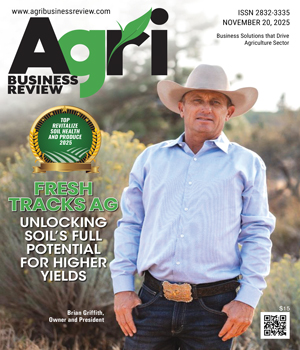
 Mike Skinner, CEO
 Soil amendment solutions that prioritize yield over soil regeneration have long dominated the agricultural industry.
Aqueus is changing the status quo by grounding its innovative chemistries in farmer-led insight. Its solutions are designed to optimize soil regeneration and drive a multifold increase in yield rate.
“We’re changing the agricultural industry in a sustainable and regenerative way by building protocols that work for farmers,” says Mike Skinner, CEO.
Aqueus’ solutions are rooted in harnessing the power of stabilized hydrogen chemistry, built for real-world farming conditions. Its patented Tyagra molecule, comprising at least ten times more hydrogen than water, buffers the pH level, loosens compact soil, and optimizes root health. Unlike sulfuric acid, which releases all protons at once, its patented molecule helps break up minerals at a slower rate, making them available in plenty for crops to absorb over time.
Its approach prioritizes nutrient availability, long-term soil vitality, and cost-effectiveness. The process is developed in collaboration with growers, validated through field trials, universities, and third-party laboratories, and refined for diverse crop systems.
Growthful, Aqueus’ revolutionary soil enhancer transcends the capabilities of traditional NPK fertilizers with stabilized hydrogen and oxygen ions that unlock soil-bound nutrients for enhanced uptake and plant vitality. In the tree, shrub, and ornamental plant segment, Growthful enhances plant health and leaf quality by conditioning soil to support stronger roots and better nutrient absorption.
In one instance, a major Florida sugarcane grower partnered with Aqueus to conduct trials on 180 acres. The outcome was nearly four tons more sugarcane per acre. Expanded trials across 1,400 acres and four soil types confirmed consistent gains, even with a 15 percent reduction in fertilizer input. Across multiple crop cycles, they averaged 3.2 tons per acre, driving increased returns and lasting soil health benefits.
Aqueus has also made significant strides in the dairy nutrition space. In one instance, it helped a producer of alfalfa, a primary feed for cattle, improve soil health for increased production. Through multiple trials, the team improved soil structure and nutrient availability, increasing yield up to three-quarters of a ton per acre. Nutritional value tests revealed significant improvement in its relative feed value and relative feed quality—key metrics for dairy producers seeking nutrient-dense forage.
Complementing its soil amendment portfolio is the pre-harvest and post-harvest solution, Freshful. This solution supports shelf life extension by helping plants retain their natural antioxidant reserves after harvest. Unlike conventional treatments that target microbial reduction, Freshful is safer and supported by its GRAS registration.
-
We’re changing the agricultural industry in a sustainable and regenerative way by building protocols that work for farmers.
Aqueus’ growth story is anchored in trusted personal networks. With three senior agronomists onboard, the team conducted rigorous trials across local farms that cultivated crops like corn, soybeans, and a range of vegetables. Collaborations with Michigan State University, Michigan Sugar Company, and Mid-Michigan Agronomy added third-party validation to the process. Driven by successful greenhouse trials, the team partnered with farmers and dealers to revitalize soil health, raise yields, and lower input costs.
Over the years, it has consistently demonstrated broad-spectrum efficacy across a range of plant systems. Trials in partnership with Mississippi State University show quantifiable improvements in turf grass quality at sites like race tracks. The company has a 95 percent reorder rate over the last two years—a badge of honor and proof that Aqueus can improve farmers’ ROI.
Aiming to expand access to year-round markets, the company is driving a strategic shift toward less seasonal regions, hiring candidates across the western and southern states. A major industry partner is set to join its dealer network, expanding U.S. coverage from 65 dealers to 165.
On a mission to ‘Do Good Things’ in agriculture, Aqueus elevates soil amendment and enriches plant growth through innovation and protocols that work for farmers and deliver measurable improvements in soil health.
Aqueus is also featured as a Top Agrochemical Company in 2023.
Why Soil Chemistry Is Reshaping Agricultural Input Decisions
Fertilizer efficiency has become harder to predict across large growing regions. Nutrient lockup, inconsistent moisture retention and declining microbial activity continue to distort yield expectations even on acreage with established fertility programs. That instability has pushed more growers toward soil amendment products that address nutrient availability rather than simply increasing application rates. Procurement teams now spend more time evaluating how products behave across different soil structures, irrigation conditions and crop cycles because uniform performance has become less common.
Acid-based amendments have existed in agriculture for decades, though many carry handling concerns or create short release windows that reduce nutrient persistence in the root zone. Buyers evaluating newer chemistry platforms increasingly focus on release behavior instead of headline nutrient claims alone. Slow mineral mobilization has become more commercially relevant in crops where excessive nutrient swings affect both yield quality and storage consistency. That distinction matters in permanent crops, row crops and forage systems where the economic penalty from uneven uptake can stretch beyond a single season.
Dealer support has also become a larger procurement factor than many manufacturers anticipated. Farmers rarely adopt unfamiliar soil chemistry through product literature alone. Agronomic interpretation, trial replication and application guidance now influence purchasing decisions almost as heavily as field data. Input manufacturers that rely entirely on direct sales channels often struggle to scale because growers want localized validation before adjusting fertility practices. Distribution expansion without technical education creates another problem. Products enter the market faster than dealers can explain placement timing, compatibility or expected field behavior.
Pressure surrounding phosphorus management has further complicated purchasing decisions in regions facing runoff scrutiny or tighter nutrient oversight. Large agricultural operators increasingly look for products that improve nutrient access while reducing dependence on heavier fertilizer programs. Procurement discussions now include nutrient density, feed quality and crop storage potential alongside raw yield performance. Hay producers, potato growers and sugar operations all evaluate soil inputs differently, yet the underlying concern remains similar. Buyers want measurable gains without introducing volatile application patterns or aggressive chemistry that damages long-term soil condition.
Research partnerships have become a practical filtering mechanism in this market. University involvement alone does not validate product performance, though independent field replication helps procurement teams distinguish between greenhouse claims and scalable field consistency. Products capable of performing across sandy soils, heavier organic soils and irrigated ground attract more attention because buyers increasingly manage acreage spread across multiple conditions. That flexibility has become especially important for growers expanding into geographically separate production regions.
Within that environment, Aqueus has built its position around hydrogen-based soil chemistry intended to improve nutrient release through gradual proton activity rather than aggressive acidification. Its product line focuses on soil treatment applications tied directly to crop performance and nutrient access. Transcript discussions pointed to multi-year sugarcane trials that produced higher yields while reducing fertilizer inputs, along with forage trials that improved nutrient density in alfalfa feed programs. The company has also expanded dealer relationships alongside agronomic education efforts, which aligns closely with how larger growers now evaluate adoption risk. For buyers weighing soil amendment investments against fertilizer efficiency pressures, that combination of measured field application and scalable dealer support makes Aqueus a credible consideration.
...Read more