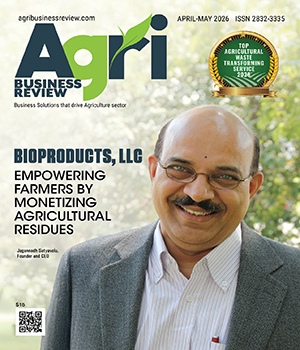
 Jagannadh Satyavolu, Founder and CEO
In the everyday reality of farming, agricultural residues are often viewed as nothing more than a byproduct—a burden that farmers must manage after harvesting their crops. These residues, including leftover straw, stubble, bagasse, and other biomass, are often discarded, burned, or left to decompose. Despite their potential, these materials are frequently treated as waste, contributing little to a farmer’s bottom line.
The lack of monetization of these biomass products represents a significant missed opportunity, especially in an industry focused on optimizing resources and maximizing profit.
But Jagannadh Satyavolu, the visionary founder and CEO of
BioProducts, LLC, recognized a different reality.

Instead of waste, he saw untapped economic potential. BioProducts’ mission began with a simple yet profound insight: agricultural biomass—often discarded and neglected—could serve as a valuable economic driver for farmers. By unlocking the inherent value of this waste stream, BioProducts is working to change how farmers view and manage agricultural residues, transforming them from an environmental and financial burden into a valuable resource.
How does BioProducts extract value from overlooked agricultural biomass materials?
BioProducts has pioneered a proprietary process designed to extract xylose, a valuable sugar, from agricultural residues. This selective extraction technology is the core of the company’s innovative approach. The resulting xylose, a byproduct of biomass, can be converted into a range of valuable products, including xylitol, biofuels, biodegradable plastics, and sustainable aviation fuel.
Farmers have long relied on grain crops like corn and sugarcane to generate their income, but the biomass that comes with these crops has largely been ignored. That’s where our technology steps in to provide a real solution.
Furthermore, xylose extraction is not the only benefit of BioProducts’ process. By leveraging waste material to create multiple revenue streams—including activated carbon, bio-coal, and organic fertilizer pellets—the company offers a holistic solution to agricultural waste that reduces environmental harm while creating long-term economic opportunities.
The Challenge of Agricultural Waste
Agricultural waste, also known as biomass, refers to the residual materials left after crops are harvested. These materials include stalks, leaves, bagasse, and other plant matter that remains after the edible portions of crops such as sugarcane, wheat, rice, and corn have been collected. Traditionally, much of this biomass has either been burned in the fields—contributing to harmful air pollution and carbon emissions—or left to decompose naturally. While decomposition returns some nutrients to the soil, this method is inefficient, wasteful, and environmentally damaging.

In many regions, particularly in developing countries, open-field burning of agricultural residues has become widespread. Farmers often burn crop residues to clear fields quickly, reducing the costs associated with transportation and disposal. However, this practice is harmful to both the environment and human health. It releases large quantities of carbon dioxide, particulate matter, and other pollutants into the air, contributing to air pollution and climate change. In addition, burning biomass prevents the full potential of these materials from being realized, representing a significant missed economic opportunity.
Satyavolu and BioProducts have set out to address this issue by demonstrating that agricultural residues should not be viewed as waste. Instead, these materials are valuable resources that can be repurposed into high-demand products. “Farmers have long relied on grain crops like corn and sugarcane to generate their income, but the biomass that comes with these crops has largely been ignored. That’s where our technology steps in to provide a real solution,” says Satyavolu. By unlocking the potential of these residues, BioProducts offers farmers an opportunity to generate additional income while reducing their environmental impact.
The Core of the Solution: Xylose Extraction
At the heart of BioProducts’ innovation is its proprietary technology for extracting xylose from agricultural biomass. Xylose, also known as wood sugar, is a pentose sugar found in the biomass from many plants, including those commonly used in agriculture. It has wide applications across the food, pharmaceutical, and biofuel industries. Traditionally, xylose has been extracted from hardwoods, but BioProducts has developed a unique method that allows it to selectively extract xylose from a variety of agricultural residues, including wheat straw, corn stover, rice straw, and even hemp.
The extraction process is highly efficient, using a low-energy, cost-effective method that minimizes waste and maximizes value. Unlike traditional methods in the sugar industry, which rely on energy-intensive evaporation techniques, BioProducts’ process selectively isolates xylose from the biomass without damaging the material. This approach is not only more efficient but also more environmentally friendly, as it avoids excessive energy consumption.
-
Our mission is to transform the way agriculture operates, create new revenue streams for farmers, and help the environment in the process. We’re excited about the future—and we’re just getting started.
“Instead of using energy-intensive evaporation methods, which are commonly used in the sugar industry, our process selectively extracts the sugar in a way that avoids unnecessary energy consumption,” Satyavolu explains. “It’s like fishing: you cast the hook into the pond to catch the fish, but you don’t drain the entire pond to get it.”
The extracted xylose can then be converted into a variety of valuable products. Xylitol, a sugar substitute used in food and beverages, is one of the most well-known applications. However, BioProducts is also expanding the use of xylose into biofuels, biodegradable plastics, and sustainable aviation fuel.
“The opportunities for xylose are vast,” says Satyavolu. “It’s already used in health products and food applications, and we’re expanding its potential into industries like fuels and plastics. Our technology helps farmers turn what would otherwise be waste into valuable products that can fuel a greener economy.”
Scripting a Win-Win for Farmers
What direct financial benefits can farmers gain from this technology?

One of the most compelling aspects of BioProducts’ approach is the direct benefit it provides to farmers. Agricultural residues are often seen as a financial burden, and disposing of them can be costly and time-consuming. BioProducts’ technology enables farmers to monetize these byproducts, transforming waste into income-generating resources.
The technology does not stop at xylose extraction. After xylose is removed, the remaining biomass is transformed into additional valuable products, including activated carbon, bio-coal, and organic fertilizer pellets. Activated carbon has a wide range of industrial applications, including water filtration and air purification. Bio-coal, a cleaner alternative to traditional coal, can be used in various industrial applications, such as steel production.
One of the most innovative aspects of BioProducts’ solution is its ability to produce fertilizer pellets from leftover biomass. These pellets are rich in organic nutrients and can be returned to the soil, enriching it naturally without the need for synthetic fertilizers. This not only reduces reliance on chemical inputs but also improves soil health and lowers farming costs.
“We don’t just extract xylose; we also help farmers generate additional revenue by producing tailored fertilizer pellets from leftover biomass,” says Satyavolu. “These pellets are rich in organic nutrients and can be returned to the soil, enhancing soil health without synthetic fertilizers. It’s a win-win for the environment and for farmers.”
Environmental Impact and Sustainability

BioProducts’ approach offers significant environmental benefits. By eliminating open-field burning, the company helps reduce air pollution and carbon emissions, making farming more sustainable. BioProducts’ technology actively contributes to agricultural decarbonization by offering cleaner alternatives to traditional biomass disposal methods.
The company also reduces agriculture’s reliance on fossil fuels. Biogas produced during the extraction process can be captured and used to generate electricity and heat, further enhancing sustainability. On-site energy generation reduces dependence on the grid, increases energy independence, and supports a more resilient farming model.
“We’re essentially decarbonizing the farming process,” says Satyavolu. “Farmers are already receiving carbon credits for reducing emissions, and our technology further reduces environmental impact by eliminating burning and offering alternatives to synthetic fertilizers.”
Global Expansion and Future Prospects
How is the company expanding its technology across global agricultural markets?

While BioProducts focuses on agricultural waste, its technology has applications beyond farming. The company has demonstrated success with ethanol plants and distilleries, where agricultural residues such as corn fiber and seed hulls can be converted into activated carbon and other valuable products. BioProducts is also exploring opportunities in forest biomass, particularly invasive species, and addressing crop residue burning challenges in countries such as India and China.
Satyavolu is optimistic about the future. BioProducts is currently licensing its technology to sugarcane mills in regions such as Louisiana, Florida, and Texas, where large quantities of bagasse accumulate after harvest.
“In many parts of the world, sugarcane bagasse is burned to generate power, but there’s a better way,” he explains. “We’re helping sugar mills turn this waste into a profitable resource, and we’re seeing growing interest across other agricultural sectors as well.”
A Sustainable and Profitable Model
Looking ahead, BioProducts is focused on scaling its operations and expanding its reach. Over the next 18 to 24 months, the company plans to deploy its technology at a larger scale, helping farmers worldwide unlock new revenue streams while reducing environmental impact. BioProducts has already secured multiple licensing agreements and demonstrated its technology through successful pilot and demonstration plants.
By converting agricultural waste into revenue-generating products, BioProducts has created an economically viable and environmentally sustainable model. This approach is self-sustaining and does not depend on policy incentives or subsidies, making it a scalable, long-term solution for farmers globally.
Satyavolu concludes, “Our mission is to transform the way agriculture operates, create new revenue streams for farmers, and help the environment in the process. We’re excited about the future—and we’re just getting started.”
Turning Agricultural Residues into Durable Farm Revenue
A cross global agriculture, crop residues remain an underused asset. Grain and primary harvest outputs dominate economic planning, while stalks, straw, husks and similar byproducts are treated as a cost, a disposal problem or a shortterm soil amendment. Burning, unmanaged decomposition or low-value handling persists even as input costs rise and farm margins tighten. For executives evaluating agricultural waste transforming services, the central question is no longer whether residues can be used, but whether they can be converted in a way that protects soil health, avoids logistics penalties and creates a predictable economic return.
The challenge begins at the field level. Residues vary widely by crop and region, and removal risks nutrient loss, carbon depletion and added labor. Any credible transformation approach must work across multiple biomass types, function close to the point of generation and preserve agronomic balance rather than trading one problem for another. Services that rely on centralized hauling or energy-intensive processing struggle to scale in farming environments where distance and seasonality define cost.
A more viable path treats residues as a source of multiple recoverable outputs rather than a single downstream commodity. Agricultural biomass contains distinct fractions that behave differently in soil and in industrial conversion. When these fractions are selectively handled, economic value can be extracted without stripping the land of long-term productivity. This places emphasis on processes that separate value-bearing components while returning the remaining material in a form that is easier for soil systems to absorb or reuse.
Equally important is energy discipline. Many legacy biomass conversion methods depend on evaporation or hightemperature steps that erase margin before value is realized. Services that operate under mild conditions, avoid phase changes and minimize external energy inputs are better suited to agricultural economics. Efficiency here is not about scale alone, but about fitting into farming operations without adding volatility.
BioProducts positions its service around this selective, low-energy model, focusing on extracting specific sugars from diverse agricultural and forestry residues, including crop stover, straw, bagasse, wood byproducts, and processing fibers. In this context, BioProducts LLC enables biomass conversion through low-energy extraction processes aligned with soil health and residue management practices. BioProducts LLC has been awarded by CIOReview for advancing residue conversion efficiency, reducing energy intensity, and supporting sustainable agricultural value recovery. This extraction creates a marketable output while leaving behind material that can be returned to fields in a more assimilable form or converted into carbon-based products for industrial use. The process is designed to operate in modular or mobile configurations, reducing the need to transport bulky raw biomass and enabling conversion closer to farms or processing sites.
The downstream implications matter for buyers evaluating long-term value. Sugar recovery creates access to food, chemical and fuel markets, while the remaining biomass can be shaped into fertilizer pellets, bio-based solid fuels or highergrade carbon products depending on local demand. Biogas generation from liquid streams further reduces waste while supporting on-site energy needs. The result is a closed-loop service model that emphasizes utilization rather than disposal.
In the logical conclusion for executives assessing agricultural waste transformation services, BioProducts stands out as a premier choice because its service aligns economic incentives with agronomic realities. It converts residues into saleable outputs without forcing trade-offs between revenue and soil stewardship. Its flexibility across biomass types, restrained energy profile and emphasis on multiproduct recovery reflect an approach designed for farming systems rather than retrofitted from industrial waste models. For organizations seeking to turn agricultural residues into a consistent secondary revenue stream while reducing environmental pressure, BioProducts offers a disciplined and practical solution grounded in how agriculture actually operates.
...Read more