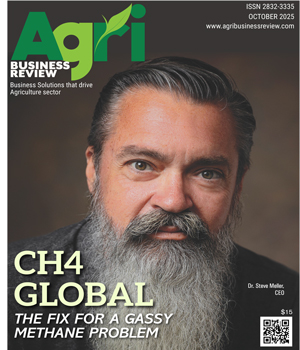
 Dr. Steve Meller, CEO
 Climate conversations rarely start at the pasture, but they should. Cows and other ruminants release methane, a heat-trapping gas that is far more potent than carbon dioxide (CO2). Unlike CO₂, which lingers for centuries, methane does its damage fast. In just 20 years, livestock emissions alone stack up to more than 12 gigatons of CO₂ equivalent, more than every nations’ annual output except China.
“The problem starts in the cow’s first stomach, the rumen. A cow’s gut microbes produce methane during digestion, which escapes through burping. Trying to capture it is challenging. It’s better to stop it from forming in the first place,” says Dr. Steve Meller, CEO of CH4Global.
Scientists already know how. A seaweed called Asparagopsis contains compounds that interrupt methane formation in the cow’s gut. Add just a pinch to feed and methane reduction is dramatic and instantaneous. It’s a proven biological brake.
What’s been missing is consistent, affordable execution and encouraging consumers to buy sustainable beef and dairy.
CH4 Global’s solution includes growing the seaweed at scale, turning it into a safe, stable additive, getting it approved and making it easy for farmers to use. All with sensible supply chain economics and ways to talk to consumers about a more sustainable source of food. CH4 Global has validated science and built out an entire ecosystem to deliver it. From cultivation to regulatory compliance to feed formulation, CH4 Global engineered Methane Tamer as a practical, feedlot-ready solution for beef cattle. Producers don’t need new systems, schedules or herd routines. They mix it in at a 0.5 percent rate of the cow’s daily intake and get measurable results.
“We’re the only company focused on this commercially, under real-world conditions, so that the entire supply chain benefits,” says Meller. “That’s why producers are already deploying it with sustainable beef appearing in butcher stores, supermarkets and restaurants.”
The Journey from Lab to Feedlot
Stopping methane at its source requires getting the right dose of product into a cow’s system every day, without fail, so that it’s always acting as food is digested.
CH4 Global began where precision was possible, where cattle stay in one place, diets are controlled and methane reductions can be accurately monitored. That controlled environment allowed the company to perfect its feed-lot formulation, test delivery methods and prove real-world performance before moving into more variable systems like dairy and beef grazing herds.
The result is a stable, dry feed supplement that uses whole dried seaweed, disperses evenly and delivers a consistent microdose in every bite. Ready availability in the cow’s digestive system around the clock ensures that you’re suppressing methane before it forms.
“We focus on more than just whether or not the technology works,” says Meller. “The supply chain has to afford it. If beef and dairy become too expensive, people don’t buy, no matter how sustainable it is.”
That unit economics logic shapes every decision. The supplement integrates seamlessly into feed routines, requiring no extra labor or equipment. It works for feed mixers, farmers and beef suppliers trying to stay cost-competitive. CH4 Global works with governments and carbon markets to align incentives and accelerate adoption.
Already approved for feedlot cattle in Australia, the supplement has shown consistent methane reductions with no adverse effects on health or weight. With performance validated, CH4 Global is scaling into new markets and adapting its formulations for grazing operations.
Scaling From the Inside Out
CH4 Global’s strategy is to scale for impact and do it with urgency. In South Australia, the company is building out commercial production to supply seaweed supplements for tens of thousands of cattle annually, backed by plans to expand output tenfold within 12 to 15 months.
-
A cow’s gut microbes produce methane during digestion, which escapes through burping. Trying to capture it is challenging. It’s better to stop it from forming in the first place
To move faster than a market-by-market crawl, CH4 Global has formed strategic alliances that unlock regional scale without giving up executional control. In Asia-Pacific, it partners with Mitsubishi Corporation; in South Korea, with Lotte International; and in Brazil and India—two of the world’s largest beef and dairy markets—it works with United Phosphorus Limited (UPL). These partners help fast-track regulatory approvals, plug into established supply chains and cultivate producer, retailer and consumer trust from day one.
Each alliance adds deep local expertise, existing infrastructure and boots-on-the-ground access to cattle producers, retailers and consumers. These partnerships give CH4 Global access to over half the world’s cattle population. Full adoption could eliminate gigatons of CO₂-equivalent emissions annually.
This speed-to-impact strategy reflects the efforts and expertise of the team behind it. Leadership includes veterans of Procter & Gamble, Pfizer and MillerCoors, experts in scaling innovation across continents and building billion-dollar businesses. About 15 percent of the team are Ph.D.-level scientists.
One Less Cow Burp
There’s more work ahead. The current product, Methane Tamer, is designed for beef and dairy feedlot. CH4 Global is already developing a version for grazing dairy cattle, with a launch target of 2026. Formulations are being validated to ensure the same consistency, safety and cost-efficiency proven in feedlots. This opens up another huge opportunity. Dairy cows contribute significantly to methane emissions, especially in countries like India, Brazil and the U.S. They also live longer and follow consistent feeding patterns, making them a great next target.
Then, a grazing version designed for diverse environments, ranging from open pastures in Brazil to smallholder farms in India. Adding this segment could multiply CH4 Global’s potential methane reductions, pushing the total potential annual impact into the multi-gigaton range.
The benefits ripple across the value chain. Dairy staples such as milk, cheese, yogurt, chocolate and ice cream could have a smaller greenhouse gas footprint. Entire dairy supply chains, from farm to factory to supermarket shelves, could cut their environmental impact without changing what ends up in your fridge.
The beauty of CH4 Global’s approach is that it doesn’t require a cultural overhaul or a shift in consumer behavior. People can continue to consume affordable meat and dairy. Farmers can keep doing what they do best. And still, emissions will fall. It’s a small change, from something as common as seaweed, with the potential to reshape how the livestock industry meets climate goals worldwide.
The New Economics of Methane Reduction in Livestock Agriculture
Methane reduction is no longer just a distant climate goal. It has become a pressing commercial concern for food producers, processors, and agricultural investors. Pressure is coming from all sides. Governments are making emissions rules stricter for livestock agriculture, and consumer brands are under more scrutiny for supply-chain emissions linked to beef and dairy. The financial risks are changing too. Companies that cannot show real progress on methane reduction may find it harder to get funding, face regulatory delays, and lose out on deals with large buyers.
Ruminant livestock is still one of the biggest sources of emissions in agriculture. Many solutions to reduce these emissions face challenges with scaling up, keeping costs low, or getting farmers to adopt them, especially in farming systems that are not unified. Because of this, buyers are now looking at greenhouse gas reduction options more from a business perspective. Scientific proof is important, but it is not enough if the solution is too expensive or would force big changes in how food is produced.
Practical deployment has become equally important. Agricultural supply chains rarely absorb technologies that depend on extensive equipment retrofits, specialized labor or inconsistent delivery systems. Feed-based methane reduction approaches have gained attention largely because they integrate into existing production environments without requiring producers to redesign herd management. Even within that segment, dispersion consistency, dosage precision and long-term feed compatibility remain significant concerns because inconsistent intake weakens emissions outcomes and complicates reporting.
Being able to adapt to different regulations now separates experimental climate technologies from those that can succeed in the market. Rules for agricultural products vary a lot between regions, especially in countries that rely on dairy and beef exports. Buyers now prefer providers who can handle scientific reviews, work with governments, and coordinate across the supply chain, instead of just offering a new product without support for getting it to market.
Commercial scalability now carries equal weight. Methane mitigation technologies often demonstrate strong pilot results yet fail once production volumes increase or distribution expands internationally. Executives evaluating providers are paying closer attention to manufacturing capacity, partnership models and supply reliability because emissions commitments tied to food production require continuity over many years. Global food companies also prefer suppliers that understand enterprise procurement structures and multinational compliance expectations rather than purely research-oriented organizations.
Economic viability ultimately remains the central pressure point across the sector. Methane reduction strategies that materially raise the retail cost of meat or dairy products face resistance throughout the value chain, regardless of environmental performance. Food producers need solutions that preserve consumer affordability while still generating measurable emissions reductions. That balance has become the defining commercial threshold for widespread adoption.
CH4Global stands out as a credible choice for organizations pursuing methane reduction in livestock agriculture within this environment. Its methane-reducing feed supplements are built to interrupt methane production during digestion without requiring major changes to existing feeding practices. The low inclusion rate makes adoption more practical for producers already managing tight cost pressures and complex supply demands. CH4Global has also concentrated on the realities that often determine whether climate technologies gain traction beyond pilot programs, including regulatory approvals, scalable production and partnerships capable of supporting global distribution. Its continued expansion into dairy and grazing systems further strengthens its relevance across a broader share of the world’s cattle industry. Equally important, its leadership approach emphasizes science-backed performance, disciplined commercialization and affordability across the agricultural supply chain, positioning it well for enterprises that require measurable climate impact without destabilizing product economics.
...Read more