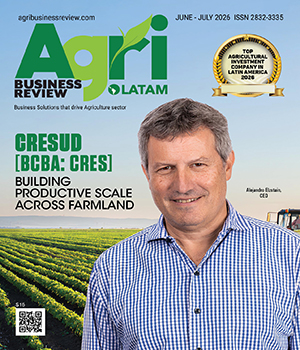
![Alejandro Elsztain, CRESUD [BCBA: CRES] | Agri Business Review |](https://www.agribusinessreviewapac.com/company_logos/730-5n7h7xyp.jpg "Alejandro Elsztain, CRESUD [BCBA: CRES] | Agri Business Review |") Alejandro Elsztain, CEO of CRESUD
Alejandro Elsztain, CEO of CRESUD operates in Argentina, Brazil, Paraguay and Bolivia on an agricultural basis, enabling large agricultural properties to remain productive amid fluctuating market conditions. CRESUD's crop, livestock and sugarcane operations all participate under the same business plan, diversifying income sources and minimizing risk from concentration in a single product category. Sometimes a drought condition could negatively affect planting operations in one part of the world while livestock prices increase significantly, maintaining agriculture stable overall.
Integrated Land and Production Management
Origins trace back to 1936 when rural financing and land administration formed the basis of the business before agricultural production became the primary focus. Expansion developed gradually afterward through farming operations, cattle activities and farmland development across South America as demand for productive agricultural land continued to rise throughout the region. Under Alejandro Elsztain’s leadership, CRESUD expanded into one of Latin America’s largest agricultural companies, managing more than 850,000 hectares across diversified crop, sugarcane and cattle operations, while agricultural commercial services also operate through FyO. BrasilAgro later expanded regional operating depth across neighboring cultivation corridors.
“We believe South America has a unique opportunity to play a leading role in global food production. For decades, we have focused on combining operational efficiency, technology and sustainable agricultural production, while also developing and enhancing the value of farmland assets across the region,” says Alejandro Elsztain, CEO of CRESUD.
Running farmland at that scale requires coordination that goes beyond traditional farm management. CRESUD evaluates acquisition through a practical lens, including soil quality, access to water, drainage and long-term land productivity. Once the property enters the portfolio, the focus shifts toward maintaining reliable output through irrigation improvement, soil conditioning and coordinated field management designed to preserve consistency over time.
CRESUD reduces commodity exposure by operating cereals, oilseeds and sugarcane alongside cattle activity, creating a more distributed production structure when drought conditions, export restrictions or currency instability begin affecting individual categories. A dry spell, changes in export rules or currency swings can hurt one part of the business, but not always all of it at the same time.
Cattle can also help relieve stress during difficult planting years. With year-to-year fluctuations in crop returns in a given area, it would be a valuable asset to have a livestock element to add stability and cash flow.
Having a mix of crops and operations only works if day-to-day farming is handled with care and attention. Across its farms, the team uses practices such as direct seeding and crop rotation to maintain the soil health and support steady yields across different regions.
Rather than applying the same approach across every property, CRESUD manages each field according to its own conditions and production needs. Seeding density, fertilizer use and crop management strategies are adjusted from one area to another instead of following a uniform formula. Soil quality, moisture levels and regional conditions can vary significantly even within the same property, so the company adapts its farming decisions accordingly.
At CRESUD, sustainability remains tied to maintaining the long-term productivity of the land rather than serving as a branding exercise. Much of the focus remains on soil preservation, erosion control, drainage management and maintaining nutrient balance across farmland that operates under demanding climate conditions. In regions where recurring droughts, heavy rainfall or shifting weather patterns can gradually weaken field performance, maintaining soil health becomes essential to keeping agricultural output stable over time.
Regional Expansion Built on Operating Control
CRESUD’s expansion across South America was driven by long-term agricultural economics. The company focused on regions where farmland still offered strong productive potential, access to infrastructure and opportunities for land value appreciation over time. Instead of aggressively expanding for scale alone, leadership focused on areas where agricultural operations could remain commercially viable amid changing market cycles. Brazil became one of the most important parts of that strategy through BrasilAgro, helping the company expand cultivation capacity while increasing exposure to some of the region’s strongest agricultural corridors and commodity markets.
Agricultural businesses concentrated in one region can be heavily affected by local droughts, export controls, currency swings or policy changes that quickly alter farming economics. By spreading operations across different parts of South America, CRESUD increased the flexibility of its agricultural model. Difficult conditions in one country or region could often be offset by stronger performance elsewhere, while the company remained well positioned to benefit from rising global demand for food and agricultural commodities.
Larger operating scale eventually introduced another layer of scrutiny around productivity, financing and capital allocation decisions. Listings on both the Buenos Aires and NASDAQ stock exchange increased visibility into debt exposure, agricultural margins and reporting consistency across production cycles. Elsztain’s involvement with IRSA also broadened overall asset exposure beyond farmland through shopping centers, office properties, hotels and mixed-use developments across Argentina.
In investor filings, the measured approach to financing exposure was also reflected with continuing targeted growth efforts. Local market debt financing reduced the weighted average cost of financing, while export sales of cattle bolstered demand and improved cattle prices. Growth is expected to be a function of market environment, not a product of leverage-induced risk.
Converting Agricultural Management into Measurable Performance
Farms that continue delivering stable output through droughts, rising input costs or volatile commodity markets usually rely on years of preparation rather than short-term fixes. Consistent soil management, field planning and precision agriculture tools help operators respond more effectively when growing conditions become unpredictable.
The long-term quality of operations often plays a major role in determining how productive and valuable the land becomes. Irrigation infrastructure, access to transportation routes, soil management practices and day-to-day operational discipline all influence how consistently farmland can perform across different agricultural cycles. In that sense, farmland functions not only as a producing asset but also as a long-term development asset whose value can improve significantly through careful management and sustained investment over the years.
Integrated production activity creates another layer of financial balance throughout changing commodity environments. Grain cultivation can deliver stronger returns during favorable export periods while cattle operations offset weaker planting conditions elsewhere. Sugar cane production adds additional exposure tied to regional processing economics and industrial demand patterns.
South American agriculture continues to attract strong investor interest because the region still has large areas of productive farmland with long-term growth potential. But ownership alone is rarely enough to generate consistent returns. Field coordination, soil management, crop planning and disciplined capital investment all play major roles in determining whether large-scale agricultural operations can maintain stable productivity amid changing market and climate conditions. Over longer production cycles, operational quality often matters just as much as the land itself.
CRESUD’s long-term growth shows a clear pattern. The company has grown by focusing on practical ways to use the land rather than following ideas that seem promising but do not work in practice. Every move has been based on what works in the field, combining farming skills, local experience and land development over time.
That consistency has remained closely tied to field execution, disciplined land management and long-term agricultural performance across changing regional conditions. CRESUD'S recognition as the Top Agricultural Investment Company 2026 reflects measured expansion, operational reliability and sustained production strength developed over decades rather than visibility alone.

![CRESUD [BCBA: CRES]](/company_logos/728-jt128.jpg "CRESUD [BCBA: CRES]")
