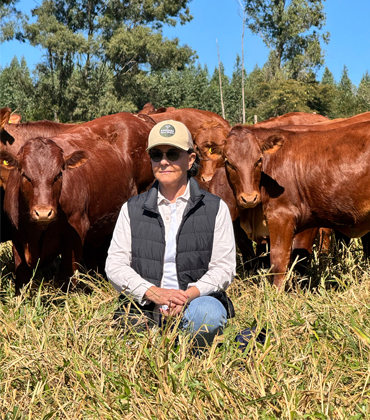
 Clélia Brissac de Camargo Pacheco, CEO
For producers seeking superior beef quality, heavier calves and a shorter time to slaughter weight, crossbreeding is indispensable. Yet across much of Brazil, that objective becomes harder to realize when less heat-tolerant European breeds depend on Fixed-Time Artificial Insemination, with its added infrastructure demands, specialized labor and stricter reproductive control.
Fazenda Santa Silvéria offers a more scalable route through Bonsmara cattle selected for natural mating, adaptability and docility, enabling clients to advance genetic improvement within pasture-based systems without moving into more intervention-heavy breeding models.
Based in Pitatininga, São Paulo, the farm serves commercial cattle operations, breeders and vertically integrated beef businesses across Brazil, along with clients in Argentina, Paraguay, Costa Rica and Colombia. Some use Bonsmara bulls in crossbreeding programs to increase weaning weights, while others raise cattle for more exacting beef markets, including their own restaurant operations.
“Our goal is the overall improvement of the Bonsmara breed, and we carry that principle through every stage of our breeding program,” says Clélia Brissac de Camargo Pacheco, CEO.
Extending Crossbreeding Through Natural Mating
How does the Bonsmara breed enable scalable crossbreeding without intensive reproductive interventions?
The Bonsmara breed was developed in South Africa by animal scientist Jan Bonsma for beef production in demanding climates. In Brazil, that origin carries direct relevance because it allows producers to extend crossbreeding beyond the cooler South and into the Southeast, Central-West, North and Northeast under natural mating conditions.
For a country whose herd is largely Zebu, that translates into immediate commercial value. Heterosis alone can lift weaning weight by around 20 percent while also helping reduce age at slaughter. This gives producers a more accessible way to increase output and keeps breeding programs practical under field conditions.
Translating Genetic Structure Into Stronger Output
Why is genetic structure important for improving performance, adaptation, and output in cattle?
Bonsmara’s value is also rooted in its genetic structure. As a Bos taurus africanus breed of the Sanga type, Bonsmara carries significant genetic distance from both British and Zebu cattle. That supports adaptation, lower mortality and dependable performance in tropical systems. Additional gains can be secured with F1 females from European breeds, where heterosis is preserved alongside resilience.
-
Our goal is the overall improvement of the Bonsmara breed, and we carry that principle through every stage of our breeding program.
Fazenda Santa Silvéria applies these genetics in systems designed to increase output per female. One model used by the farm and some of its clients pairs Bonsmara bulls with precocious commercial heifers at around 14 months of age. These females enter the breeding season at roughly 300 kilograms and continue growing through pregnancy. After calves averaging about 220 kilograms are weaned, the females are then brought to finishing weights of approximately 500 to 520 kilograms. In practical terms, each female produces a calf while also generating more than 300 kilograms of additional output.
These efficiency gains are matched by the breed’s contribution to beef quality. Three-way crosses involving Nelore, Angus, and Bonsmara make it possible to produce premium-quality beef entirely on pasture. In purebred animals, the beef reaches high standards of tenderness, flavor and juiciness.
Underpinning Results Through Selection Discipline
In what way do selection criteria and management practices influence long-term breeding outcomes?
These outcomes are reinforced by a breeding program that combines performance records, visual and functional evaluation, carcass assessment and genomic ancestry in mating decisions. Adaptation remains a strict selection criterion, and animals that do not hold up under local conditions are removed from the program. That standard is shaped by the farm’s own environment, marked by very hot summers and cold winters.
Temperament is given equal weight because it affects both handling and output. Docile cattle are easier to manage, reduce the risk of accidents for workers and perform better under low-stress conditions. Feed efficiency is another defining trait, consistent with Jan Bonsma’s original emphasis on animals that convert feed effectively into meat.
Anchoring Sustainability in Productivity
The farm’s sustainability model is tied directly to output. More efficient animals produce less methane per unit of production, while well-managed Brachiaria pastures maintain active plant growth and strengthen carbon sequestration in the soil. In this system, genetics, nutrition and management work together to support both environmental and economic performance.
As tropical beef production faces rising pressure to deliver quality, efficiency and resilience together, Fazenda Santa Silvéria is refining a breeding model grounded in practical performance and long-term genetic progress.
Selecting High-Performance Cattle Breeding Solutions for Scalable Beef Production
Beef producers across tropical and subtropical regions face a persistent constraint that goes beyond yield: how to achieve consistent meat quality without introducing systems that strain labor, infrastructure or environmental limits. Conventional approaches to genetic improvement often rely on tightly managed breeding programs, yet many of these models work only in controlled environments that do not reflect pasture-based realities. This gap between genetic potential and field execution continues to shape procurement decisions for breeding solutions.
A critical pressure point lies in the method of crossbreeding itself. Fixed-time artificial insemination has become a widely used pathway to introduce desirable traits, but it demands technical expertise, infrastructure investment and precise timing. In large, dispersed grazing systems, these requirements introduce variability and cost that dilute expected gains. Natural mating, when paired with the right genetic base, shifts this equation by enabling crossbreeding under field conditions without operational strain. The distinction is not procedural but structural: whether genetic improvement integrates into existing systems or forces systems to adapt around it.
Climate adaptability introduces another layer of decision complexity. Many high-performance breeds show limitations outside temperate regions, particularly under heat stress. This creates a fragmented breeding strategy where solutions vary by geography rather than scale. Breeding programs that prioritize adaptability at the genetic level allow producers to maintain performance across diverse climatic zones, reducing dependency on localized solutions. This continuity becomes essential in markets where herd expansion or geographic diversification is part of long-term planning.
Productivity gains are increasingly evaluated in terms of biological efficiency rather than output alone. Improvements in weaning weight, feed conversion and reproductive efficiency must align with broader economic and environmental considerations. Crossbreeding systems that unlock heterosis under practical conditions can materially increase output per animal, often without proportional increases in input. This has implications not only for profitability but also for sustainability metrics, where higher efficiency reduces emissions intensity per unit of production.
Temperament and manageability are often treated as secondary traits, yet they directly affect handling safety, labor efficiency and even meat quality. Breeding solutions that embed docility into selection criteria reduce friction across the production cycle, from pasture management to finishing. This alignment between animal behavior and operational efficiency is rarely achieved through isolated trait selection; it requires a coherent genetic strategy that integrates performance with practicality.
Fazenda Santa Silvéria positions itself within this framework by focusing on breeding solutions that prioritize adaptability, fertility and productivity under pasture-based systems. Its emphasis on the Bonsmara breed reflects a deliberate approach to enabling natural mating as a viable crossbreeding method across diverse Brazilian conditions. By maintaining genetic distance from both British and Zebu cattle, it enables heterosis in a way that enhances performance while preserving resilience.
The farm integrates performance data, visual evaluation and genomic analysis to guide mating decisions, ensuring that selection aligns with functional outcomes rather than isolated metrics. Its breeding approach supports systems where producers can increase weaning weights, improve feed efficiency and produce high-quality beef without reliance on intensive infrastructure. For executives evaluating breeding partners, it offers a model that aligns genetic advancement with field-ready execution, making it a compelling choice for scalable, pasture-based beef production.
...Read more