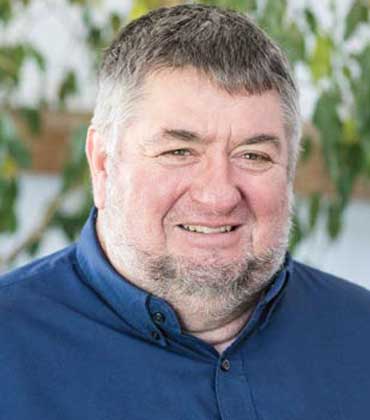
 Kenneth Kuhns, Owner
 Modern agriculture is evolving rapidly, bringing new challenges. One significant pain point for farmers in the equine industry is handling small square bales. In the early 2000s, the hay industry faced a growing disconnect between equipment and market needs. Most bale-handling systems were built for heavier 60-pound bales, while horse owners preferred lighter 40- to 45-pound bales. This mismatch left farmers struggling with inefficiency, rising labor costs, and a shrinking labor pool.
Tackling these issues head-on, Norden Mfg emerged as an innovator, transforming the industry. The company introduced the Norden Accumulator, an automated bale-handling system that minimizes the need for manual labor, improves efficiency and profitability, and increases scalability.
“Our equipment allows farmers to manage thousands of bales with precision and ease, ultimately reducing costs and boosting productivity. The Accumulator frees farmers by automating traditionally labor-intensive tasks, allowing them to focus on expanding their operations without the usual headaches associated with increased workloads,” says Kenneth Kuhns, owner of Norden Mfg.
Scalable Solutions for Farms of All Sizes
One of the most impressive aspects of Norden Mfg’s product line is its scalability. Whether a farm produces 1,000 bales annually or 140,000, Norden Mfg offers right-sized solutions tailored to the operation’s needs. Farmers can start with a smaller 10 bale system and easily scale up to an 18 bale system as their business grows—without requiring a proportional increase in labor or significant additional investment.
-
Our equipment allows farmers to manage thousands of bales with precision and ease, ultimately reducing costs and boosting productivity. The Accumulator frees farmers by automating traditionally labor-intensive tasks, allowing them to focus on expanding their operations without the usual headaches associated with increased workloads
For instance, a farm producing 10,000 bales per year might initially invest in the company’s system to alleviate labor shortages. As the farm grows and production increases to 30,000 or more bales annually, the same equipment can continue to meet demand, transforming a small operation into a thriving, profitable business. This adaptability gives farmers a competitive edge in a constantly changing market.
Norden Mfg’s innovation extends beyond bale-handling equipment. The company has expanded its product offerings to address other challenges in hay production, helping farmers improve efficiency and product quality. For example, Norden’s hay rake reduces contamination to ensure cleaner, higher-quality hay, while the alfalfa tedder promotes faster drying, preserving the hay’s nutritional value and making the harvesting process more efficient.
The company’s expertise goes beyond agriculture. Norden Mfg also applies its advanced engineering capabilities to custom fabrication projects for other original equipment manufacturers (OEMs). This diversification demonstrates its technical prowess and ability to develop specialized solutions across industries.
A Trusted Partner for Long-Term Success
Norden Mfg isn’t just an equipment provider; it is a true partner to the farming community. The company’s mission is rooted in solving real-world challenges and supporting farmers in their quest for long-term success. Its commitment to innovation is matched by a dedication to understanding and addressing farmers’ evolving needs. Every product is designed with the farmer in mind, combining durability, efficiency, and adaptability to ensure maximum return on investment.
For farmers looking to overcome labor shortages, streamline operations, or expand their businesses, Norden Mfg offers a proven pathway to success. More than just a leader in hay handling, it is shaping the future of modern agriculture— continuously evolving its product line to meet industry demands and deliver tangible results.
Small Square Bale Handling Systems and Labor Efficiency in Hay Logistics
Pressure across livestock and equine supply chains has shifted from production capacity to labor availability and time-bound handling constraints. In small square bale operations, the bottleneck is rarely harvesting itself but the repeated manual touchpoints required to move hay from the field to storage and onward to end users. Each additional handling step increases labor dependency at a time when crews are thinner and seasonal windows are less forgiving. Decision-makers are increasingly forced to evaluate systems not only on throughput but also on how consistently they reduce human intervention between bale formation and final delivery.
A recurring constraint in this segment comes from the gap between bale format expectations and the equipment built to process them. Many systems in circulation were built around heavier bale weights that do not align with current equine and specialty feed preferences, where 40- to 45-pound bales dominate. That disconnect introduces inefficiency in stacking, transport density and handling ergonomics. Equipment that cannot adapt to these preferences tends to push operations toward additional manual correction, which weakens the intended labor savings. The more effective approaches in this space are those that stabilize bale handling around consistent sizing while reducing variability in movement from ground pickup to wagon loading.
Field-to-storage flow has become the defining measure of system value, particularly where farms are scaling output without proportional increases in workforce capacity. Accumulator-based configurations are increasingly evaluated on how smoothly they integrate into existing baling and transport routines rather than requiring parallel workflows. Systems that maintain a straightforward connection to balers while allowing flexible wagon or collection sizing tend to reduce friction in daily operations. Ease of deployment also carries weight, not in terms of novelty but in how predictably operators can configure equipment across different production volumes without reengineering the process each season. This extends into broader adaptability, where farms producing a few thousand bales operate within the same equipment logic as those scaling significantly higher output.
Longer-term purchasing decisions in this segment are increasingly shaped by whether a system can support incremental expansion without forcing replacement of core components. Equipment that allows operators to adjust capacity, stack configuration and downstream handling tools tends to remain viable across changing production cycles. The most durable preference emerging in the market is for systems that preserve simplicity in operation while still accommodating variability in bale movement, storage density and transport routing across different farm sizes.
Within this landscape, Norden Mfg positions its small square bale handling systems around accumulator-based workflows designed to streamline field pickup and downstream stacking. Its equipment line integrates accumulator configurations with complementary handling tools such as bale grabs and tie systems that support movement from ground to wagon with fewer manual transitions. The design emphasis remains on matching bale volume requirements across a wide production range while maintaining straightforward setup and operation in field conditions. Additional development in related hay-handling equipment and custom fabrication extends its relevance beyond a single machine category, supporting operators who require adaptable configurations rather than fixed-capacity systems.
...Read more