Thank you for Subscribing to Agri Business Review Weekly Brief


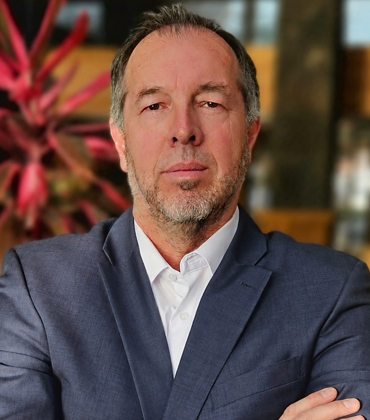 Rodrigo Sánchez, Founder and Director
Aquaculture and agriculture are closely linked through aquafeed, as salmon diets increasingly use soy and other plant-based ingredients, connecting both industries through nutrition, innovation, food security, and sustainable protein production.
Bridging that knowledge gap, Oceanic Food Solutions brings more than 25 years of experience in Chile's salmon industry. The company supports clients in evaluating technologies and business models against their specific needs, helping them compare alternatives and determine the approach that best fits their objectives. Its role extends from the earliest stages of brainstorming and business-model development through innovation, patent support, intellectual property protection, and the commercialization of new technologies.
“We bring up-to-date know-how to help aquaculture businesses decide whether to adapt their current business model, adopt new technologies, or combine both,” says Rodrigo Sanchez, founder and director.
This expertise has positioned Oceanic Food Solutions at the forefront of some of the most important technological developments. The company served as an advisor to CopperNet, supporting the development of copper alloy mesh systems and submersible cages for coastal aquaculture. The knowledge gained through this collaboration now forms part of its broader consulting capabilities, providing clients with firsthand insights into technology innovation and implementation.
Beyond coastal aquaculture, Oceanic Food Solutions also works with Ocean Arks to develop mobile vessel technology for offshore aquaculture. Designed to enable aquaculture operations in open ocean environments where conditions more closely resemble the species' natural habitat, the technology reflects one of the emerging production models reshaping the industry.
Rather than advocating offshore production as a replacement for conventional farming, the company views it as an important alternative the industry should evaluate alongside existing production models.
-
We bring up-to-date know-how to help aquaculture businesses decide whether to adapt their current business model, adopt new technologies, or combine both.
That decision-support role extends beyond individual technologies. By working directly with Ocean Arks, the company helps clients understand how emerging production models could expand opportunities in new markets, including regions with significant seafood demand, like the U.S., and assess their operational and commercial implications.
To support those decisions, Oceanic Food Solutions operates through a project-based consulting model, assembling specialists with expertise tailored to each client's specific needs. Its work spans production model development, simulation tools, ocean mapping, and innovation strategy. By analyzing more than 100 years of oceanographic data, including water temperature, currents, and wave conditions, the company supports site selection for different fish species and production environments.
Oceanic Food Solutions has also developed simulation tools and production models for yellowtail farming in Mexico and Chile. Its salmon models compare traditional coastal farming with emerging offshore systems by evaluating operational and cost variables across different production scenarios. These tools enable clients to compare production alternatives, understand the impact of different business decisions, and make more informed investment choices. Together with its work in innovation, intellectual property protection, and commercialization, the company transforms concepts into market-ready solutions.
As aquaculture enters a new phase of development, Oceanic Food Solutions is expanding its focus beyond Chile to global markets, including opportunities in the U.S., Central and South America. The company’s vision is centered on supporting a more sustainable and technology-driven future for seafood production, where innovation benefits producers, consumers, and the environment.
While many aquaculture businesses are occupied with daily production challenges and changing ocean conditions, they often have limited time and resources to evaluate the future strategically. Recognized as the Top Aquaculture Business Development Consulting in Latin America, Oceanic Food Solutions continues to help them navigate industry change and determine the right strategy for their operations through its extensive industry experience and technological knowledge.
Building New Aquaculture Business Models beyond the Coast
Coastal aquaculture now carries a planning burden that balance sheets often hide until late in the investment cycle. Feed economics move faster than site approvals. Local resistance narrows the room for expansion. Warmer waters, stricter permits, disease exposure and feed volatility can turn a promising production plan into a margin problem before the first harvest reaches a buyer. Many projects do not fail on biology alone. They stall when commercial assumptions are left untested, or when the site decision is treated as a technical exercise rather than a long-term business exposure. For executives evaluating aquaculture business development consulting, the question is no longer whether an adviser understands fish farming. It is whether it can test the business model against ocean conditions, license constraints, capital timing and market access before management commits to a path.
Legacy consulting models often begin with the existing farm footprint. That can be useful for incremental gains, but it leaves a blind spot when the real decision is whether to adapt coastal production, move toward more open-water systems, build a hybrid model or defer the investment. A stronger advisory partner should help management compare these options without forcing a predetermined answer. Cost modeling matters here, but only when it includes the variables that actually shift performance such as site exposure, species behavior, feed inputs and harvesting logistics. A spreadsheet detached from production reality gives executives comfort rather than guidance.
Technology review also has to move beyond vendor screening. Many aquaculture companies are being asked to judge systems that alter the production model itself. Submersible cages, stronger containment materials, ocean-based vessels and data-led site selection can change capital needs, permitting pathways, labor planning and financing timing. The adviser’s role is to translate technical promise into a business sequence that executives can challenge. Can the concept be protected? Can it be piloted before scale? Does it reduce cost exposure or merely move it to another line item? Who owns the learning after trial? These questions separate useful advisory work from enthusiastic technology commentary.
Confidentiality creates another pressure point. Much of the best work in aquaculture development happens before public disclosure, when a company is deciding whether a new production zone or species model deserves capital and whether intellectual property can be defended. Consulting support must be structured around project discipline rather than generic advice. Management needs access to specialists when the assignment requires it, but it also needs one accountable lead who can hold the commercial logic together. Fragmented expertise can slow decisions when timing is already tight.
Oceanic Food Solutions combines more than 25 years of aquaculture experience with business-model development for companies navigating industry change. Its work spans idea development, business advisory for new projects, support for Ocean Arks Tech, and advisory experience with Coppernet, including the development of copper-alloy mesh systems and submersible cages. Through a flexible project-based consulting model, the company brings together specialists according to each client's needs. For companies evaluating new technologies, offshore production models, production costs, and intellectual property protection, Oceanic Food Solutions supports the journey from innovation and business-model development to commercialization and market adoption.
...Read more
Company
Oceanic Food Solutions
Management
Rodrigo Sánchez, Founder and Director
Description
Oceanic Food Solutions focuses on sustainable aquaculture consulting, developing innovative ideas and business solutions for ocean-based food production. The company supports projects combining engineering, fish production expertise, and technology to create scalable, profitable, and environmentally responsible solutions that advance the future of global aquaculture innovation.
