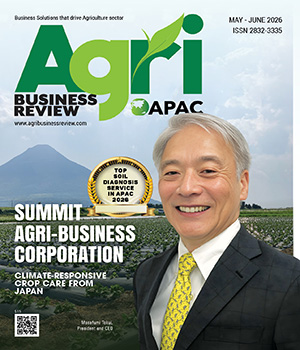
 Masafumi Tokui, President and CEO
Climate change is reshaping Japan’s production landscape for growers in every major region. Longer heatwaves, sudden downpours, and sharper temperature swings are compressing decision windows and increasing the cost of error in nutrient management and soil stewardship. Against this backdrop,
Summit Agri-Business Corporation delivers climateresilient crop care by combining three strengths in one operating model: (1) product development in fertilizers and biostimulants, (2) rigorous, data-driven soil diagnosis, and (3) disciplined field implementation supported by a nationwide network.
Recognized as a Top Soil Diagnosis Service in 2026, the company’s approach begins with helping growers see their fields clearly. When clients start working with Summit Agri-Business, they gain an objective understanding of soil characteristics such as nutrient balance, pH, and organic matter, based on accurate sampling and analysis. This clarity improves immediate field decisions—fertilizer rates, input selection, and timing—while enabling mid- to long-term strategies that strengthen soil productivity over multiple cropping cycles.
At the core is an end-to-end methodology that connects “sample, interpret, and implement.” Field sampling is designed to capture real production conditions; results are analyzed through an in-house soil analysis framework; and recommendations are translated into field-ready fertilizer and input designs aligned with local climate, soil type, crop characteristics, and grower objectives. Because Japan’s agricultural environments vary dramatically from Hokkaido to Kyushu, Summit Agri-Business does not rely on standardized prescriptions. Instead, diagnostics and nutrient programs are regionally optimized and continuously refined.
 How does Summit Agri-Business integrate soil diagnosis with field implementation and validation processes?
What differentiates this model is verification. Even the most carefully designed fertilization plan can perform differently than expected in real fields. For that reason, Summit AgriBusiness emphasizes on-site validation trials to confirm whether recommendations deliver measurable results. Regional teams do more than advise and supply inputs—they run trials, capture outcomes, and feed learnings back into the advisory process. This creates a practical, evidence-based loop that builds repeatability from season to season.
Regional Optimization in Action: Nutrient Strategy and a Kagoshima Case
The company also helps growers reframe soil from an annual cost item to a strategic production asset. One frequent challenge is phosphorus management: phosphorus can support root system development, which is increasingly important under climate stress, yet excessive phosphorus accumulation can elevate soilborne disease risk and erode long-term soil function. Summit Agri-Business supports balanced nutrient design while advancing techniques that improve the uptake of residual phosphorus already present in the soil—helping clients protect soil health and strengthen farm profitability over time.
A recent example from Kagoshima Prefecture: Japan’s largest sweet potato producing region—illustrates how analytics become action. Rising temperatures have caused even sweet potatoes, traditionally considered heat- and drought-tolerant, to show summer wilting symptoms and yield decline. Summit AgriBusiness analyzed soil data from 553 sweet potato fields collected between 2020 and 2023 and identified a key pattern: 64% of fields showed elevated pH (≥5.6) alongside calcium deficiency.

With preliminary trials indicating that calcium nutrition can support heat tolerance, the company promoted the adoption of calcium sulfate as a corrective measure. Field feedback reported reduced wilting and improved yield stability, validating the value of region-specific diagnosis paired with execution support.
Importantly, soil insights are not treated as one-off inputs for fertilizer design. They are embedded into each client’s broader farm planning cycle—linking diagnosis results with cropping plans and input allocation decisions—so that nutrient-use efficiency improves, crop strategies become more resilient, and land stewardship goals are supported in a measurable, practical manner.
A Practical Case of Providing a Solution to Foot Rot Disease: In sweet potato production in the Southern Kyushu region, foot rot disease has been an ongoing issue since 2018. To address this challenge, we conducted surveys on disease incidence alongside multiple growth-related assessments, which led us to identify a potential contributing condition.
Specifically, our observations suggested that large fluctuations in nitrate ion concentration within stems and leaves during the growing period may increase the likelihood of foot rot disease development.
To investigate this relationship, a single field was divided into 28 test plots, each with different fertilizer conditions. In each plot, the nitrate ion concentration of vines (the tips of the primary stems) was measured on a monthly basis throughout the growing season. The degree of fluctuation in nitrate ion concentration during the growth period was calculated as a coefficient of variation and plotted on the X-axis, while the incidence rate of foot rot disease in each plot was plotted on the Y-axis to create a scatter diagram.
Why is balanced nutrient management critical for maintaining soil health under climate stress conditions?
The analysis revealed that once the coefficient of variation exceeded approximately 150%, the incidence of foot rot disease increased sharply. This finding suggests that nutrient deficiency during the growing period—particularly unstable nitrogen supply—may be involved in the onset of foot rot disease.

Based on these results, SAB designed fertilizer formulations incorporating controlled-release nitrogen and potassium-coated components. While promoting and disseminating these products to growers, we continue to monitor cases where disease incidence has declined, further validating this approach as a practical solution for disease suppression in the field.
A Practical Example of Promoting Food-Derived Soil Reductive Disinfection Material: Soil reductive disinfection using sugar-containing diatomaceous earth began to be promoted in various regions from 2020. The approach gained attention because it not only helps utilize underused resources, but is also environmentally friendly—and in many cases has been reported to deliver results that outperform conventional chemical soil treatments.
However, adoption initially progressed slowly. Farm operations differ widely in terms of available equipment, machinery, and labor capacity, and field conditions also vary from site to site. Under these circumstances, manual-style, standardized guidance could not provide optimal recommendations for individual growers, which became a barrier to widespread implementation of this soil disinfection method.
At Summit Agri-Business Corporation, many of our sales staff also serve as agronomists, and we work closely with our technical divisions while maintaining an extensive archive of field cases and practical know-how. This enables us to provide tailored, farmspecific guidance that matches each grower’s operational resources and field conditions. As a result, we expect dissemination to reach approximately 600 tons within three years (the annual generation volume of sugar-containing diatomaceous earth is about 4,000 tons per year).
Biostimulant Innovative Solutions Designed for Today’s Climate Conditions
With this soil-first, results-verified foundation, Summit Agri-Business develops and deploys climate-responsive solutions that help growers maintain stable production under increasingly difficult conditions.
“Sansobakutan” – Continuously Supplies Oxygen During Heavy Rains and High Heat
In recent years, Japan has experienced prolonged heatwaves and dry periods, which have led to increasingly frequent short-duration torrential rains. As a result, while the oxygen demand of crops has risen, the oxygen supply to their root zones has become insufficient, causing a decline in cultivation precision.
“Sansobakutan” is a proprietary biostimulant developed to support root respiration and maintain stable physiological activity even under oxygen-deficient soil conditions or heat stress. Unlike conventional oxygen-releasing agents, it supplies oxygen continuously into the soil by mixing two types of liquid immediately before application.
Multiple field observations across fruit, vegetable, and rice crops have demonstrated its consistent performance.
 “Nikatetsu FULL+”
 – Supplies Stable Ferrous Iron to Correct Temperature- and Alkaline-Induced Deficiencies
In alkaline soils, which account for 30 percent of the world’s farmland, crops are unable to absorb iron, resulting in severely suppressed growth.
Additionally, during periods of drastic temperature fluctuations, crops cannot keep up with iron uptake, leading to leaf chlorosis and insufficient root development.
In what ways do biostimulants support crop resilience under extreme weather and soil conditions?
Plants can only absorb iron in its ferrous (Fe²⁺) form, but many ferrous iron materials oxidize after application, preventing crops from achieving satisfactory absorption rates. “Nikatetsu FULL+” uses proprietary technology to suppress oxidation after application, delivering high absorption efficiency and strong iron-supplementation effects. This enables it to solve difficult challenges that occur across various regions.
“Touganyu keisoudo” – Food-Derived Soil Reductive Disinfection Material
“Touganyu keisoudo” offers a sustainable alternative to traditional chemical fumigation. Made from food-derived materials, it activates biological reduction processes in the soil, suppressing soil-borne pathogens while simultaneously contributing organic matter. The approach aligns with global agricultural trends emphasizing reduced chemical inputs, improved soil health, and environmentally responsible production practices. Growers appreciate its ease of use and compatibility with integrated pest and soil management systems.
-
Japan’s agricultural environments vary dramatically from Hokkaido to Kyushu, so we do not rely on standardized prescriptions. Instead, we regionally optimize and continuously refine our diagnostics and nutrient programs.
Commitment to Japan’s Growers
Summit Agri-Business Corporation continues to strengthen its nationwide activities—advancing R&D, conducting multiregion field validations from Hokkaido to Kyushu, and providing technical support through a direct sales network closely connected to producers. By focusing on climate-responsive product development and on-farm problem solving, the company remains dedicated to supporting resilient, high-performance crop production across Japan.
Sumitomo Corporation Group’s Fertilizer Value Chain Expansion in APAC
Summit Agri-Business Corporation is part of the Sumitomo Corporation Group, with Sumitomo Corporation as its shareholder. Leveraging its global network and trusted relationships, Sumitomo Corporation engages in diverse business activities, including trading, distribution, and domestic and international investments.
In the global agricultural industry, Sumitomo Corporation began its fertilizer-related business in the 1970s, initially focusing on the import and export of fertilizers. Since then, the Company has advanced into overseas markets to introduce local production and distribution projects, in addition to further enhancing its expertise in fertilizer raw material trading.
Within the APAC region, Sumitomo Corporation Group has invested in operating companies engaged in the fertilizer business in China, Australia, Malaysia, and Vietnam.
The following is a list of our group companies operating in the fertilizer business across the APAC region.

Soil Intelligence for Sustainable Agricultural Productivity
Modern agriculture faces a paradox. Yields must rise to meet global food demand while soil quality in many production regions steadily declines. Agricultural executives responsible for land productivity, input efficiency and long-term farm economics increasingly recognize that fertilizer programs alone cannot sustain output. Reliable soil diagnosis has become a foundational discipline that informs nutrient strategy, crop planning and environmental stewardship across multi-year production cycles.
Many agricultural operations still rely on generalized nutrient programs developed from historical assumptions about soil fertility. Uniform fertilizer application often masks deeper imbalances that accumulate over time. Nutrient excess in some cases reduces crop resilience or contributes to soil degradation, while hidden deficiencies limit root development and plant vigor. Climate variability further complicates these dynamics, increasing pressure on soil systems that were once considered stable. Decision makers, therefore, require analytical clarity about what is happening beneath the surface of their fields.
Effective soil diagnosis begins with accurate sampling and disciplined analytical interpretation. Field sampling practices must capture true soil conditions rather than surface variability, while laboratory analysis must translate chemical indicators into agronomic meaning. Data that just lists nutrient levels rarely guides meaningful farm decisions. Agricultural leaders benefit from analysis that connects soil chemistry, crop requirements and regional environmental conditions into clear management guidance.
Interpretation becomes even more critical as agricultural landscapes vary widely across regions and crop systems. Soil structure, climate patterns and cultivation practices differ significantly from one production area to another. Diagnostic frameworks that ignore regional conditions often generate recommendations disconnected from real field behavior. Agricultural executives evaluating soil diagnosis services, therefore, look for providers capable of adapting analytical models to local soil environments and crop characteristics rather than relying on standardized prescriptions.
Long-term value also depends on translating analytical insight into consistent field practice. Soil diagnosis creates impact when recommendations guide fertilizer design, nutrient balance and soil improvement strategies across multiple growing seasons. Stable yield improvement generally reflects disciplined cycles of measurement, intervention and verification rather than single-season adjustments. Farm managers increasingly prioritize advisory partners that maintain continuous engagement with production sites, tracking how soil conditions evolve and adjusting recommendations as evidence accumulates.
Agricultural decision makers also face a growing need to treat soil as a strategic production asset rather than a static input platform. Nutrient management decisions influence soil health, disease pressure and root system strength over time. Phosphorus accumulation offers a common example. Fertilization intended to stimulate plant growth can gradually create conditions that promote soil-borne diseases or limit productive capacity if not carefully monitored. Diagnostic systems that visualize these long-term trends allow agricultural organizations to shift from reactive nutrient management toward disciplined soil stewardship.
Integration with broader farm planning further distinguishes advanced soil diagnosis services. Analytical results gain value when they inform cropping strategy, fertilizer allocation and sustainability objectives across entire farm operations. Agricultural leaders increasingly evaluate soil intelligence through its ability to guide both immediate field decisions and multi-year land management strategies that support productivity while preserving soil integrity.
Summit Agri-Business Corporation demonstrates this integrated approach to soil diagnosis. It conducts structured soil analysis that begins with precise field sampling and continues through in-house analytical interpretation designed to translate laboratory data into practical agronomic guidance. Its diagnostic work considers regional climate patterns, soil types and crop characteristics to produce recommendations aligned with real field conditions. Clients gain clear visibility into soil properties such as nutrient balance, pH and organic matter levels, enabling fertilizer strategies that support both current crop performance and long-term soil improvement.
Field-based advisory support and regional trial programs allow it to validate recommendations across multiple production seasons, strengthening confidence in the agronomic outcomes achieved. Data drawn from hundreds of analyzed fields further informs region-specific nutrient interventions, illustrating how disciplined soil analysis can stabilize crop performance while protecting soil as a long-term production asset.
...Read more